


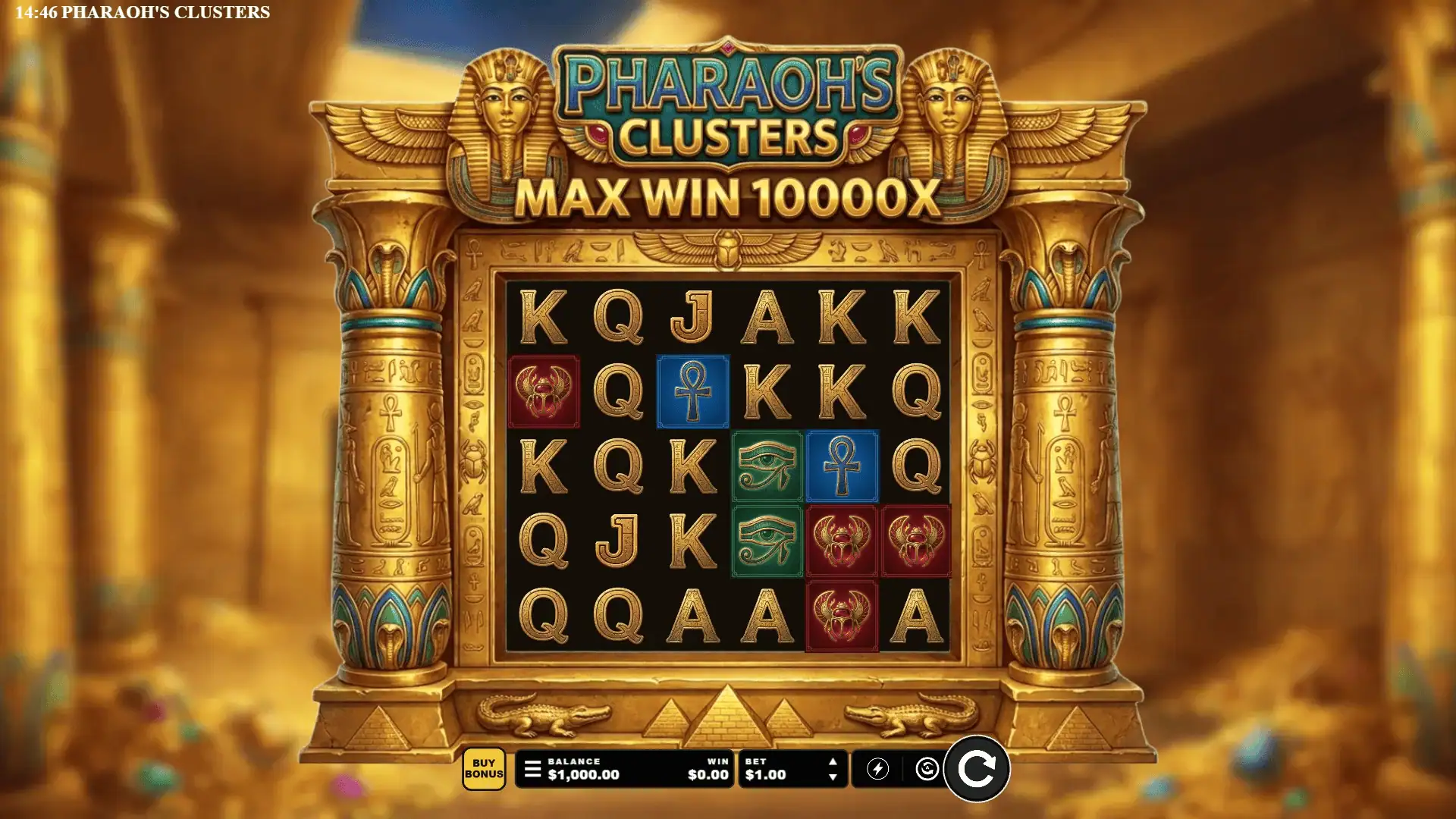
Pharaoh's Clusters by Similar Games places a six-column, five-row symbol field in an ancient Egyptian treasure setting. Connected groups form the wins, and a paying result leads into cascades that bring replacement symbols onto the board. The central attraction is watching whether the spaces opened by one win allow another cluster to form.
Quick take: An Egyptian cluster game where the next refill can be as interesting as the initial spin.
Theme and Gameplay
The pharaoh-and-treasure theme frames a broad 6×5 grid. During ordinary play, the useful task is to scan for connected matching symbols across that field. The shape of a group matters more than following a single fixed route through the columns.
Once a cluster pays, the board changes through the cascade sequence. Replacement symbols occupy the spaces opened by the win, giving the result another opportunity to produce a paying combination. A first win is therefore a starting point worth following rather than an immediate reason to look away.
Slot Features
Cascades are the feature that most directly changes the rhythm of Pharaoh's Clusters. A spin can develop through further combinations as replacement symbols arrive. Each refill deserves a fresh look because the arrangement that produced the previous win has changed.
The interesting interaction is between the spaces a paid group leaves behind and the symbols that fill them. A cluster in one part of the grid can alter what happens around it on the next stage. This gives the board a visible sequence to follow without requiring the player to trace paylines.
Feature focus: After a cluster pays, watch the replacement spaces and the matching symbols beside them; that is where the next combination can develop.
RTP and Win Potential
The listed RTP is 96%, with a maximum win of 10,000x the stake. RTP describes a long-term theoretical return, while the maximum marks the upper limit of a result. Neither tells you how far an individual cascade sequence will continue.
My Thoughts On This Slot
The appeal here rests on the board doing something after a win. Connected groups are easy to understand as an idea, and the refill gives each successful cluster a consequence beyond its immediate payment. That makes the Egyptian setting a comfortable frame for a game about watching arrangements change.
Scanning thirty positions takes more attention than reading a compact line game. Someone who wants every spin settled at its first stop may find that less convenient. Pharaoh's Clusters is more inviting when you enjoy following the same result through successive changes and spotting the next group as it forms.
Final Take: A spacious Egyptian grid whose cluster-and-refill sequence supplies the main reason to keep watching.